

Trends & Insights from an Industry Pioneer
About Subsurface Reflections:
The goal of this blog is to share interesting and inspiring articles related to subsurface imaging and geophysics. Written by experts in the field of geophysics, ground penetrating radar, software development and data analysis, this is a source for insights about the practical application of technology in the field of subsurface imaging and a place to shed light on common misconceptions in the industry.
No Results Found
The page you requested could not be found. Try refining your search, or use the navigation above to locate the post.
Ground Penetrating Radar (GPR)

Dr. Peter Annan
Founder & CEO
Peter is the CEO of Sensors & Software. His scientific research has been recognized worldwide with numerous awards for his pioneering work in ground penetrating radar (GPR) instruments and data analysis methods. He has authored multiple scientific publications, patents, and technical reports and served on various government and professional committees.
Finding Graves in Cemeteries
Finding Graves in Cemeteries
Encountering unmarked or improperly marked graves can be difficult and create embarrassing problems for those responsible for cemeteries. While headstones and markers are normally positioned over burial sites, these makers can be lost or miss-positioned as time passes.
Some cemeteries are hundreds of years old, encountering unmarked graves is a common occurrence. This case study from Alabama, USA shows effective use of GPR for locating graves. The Noggin SmartCart is a compact, portable and rugged GPR for smooth to moderately rough field conditions.
Cemetery in Alabama unmarked, detailed GPR grid survey was carried out.
Problem
Locating graves can be challenging. There is often no surface expression of the burial location. Even if markers are present they may be inaccurately positioned. The challenge is to explore the subsurface without disturbing the soil.
A grave is a relatively well defined target, the size is typically 0.5 by 2m and depth is normally less than 2m. Further, the act of excavating the soil for burial radically disturbs the natural soil structure.
In this case study, a cemetery in Tuscaloosa, Alabama was unsure of the locations of graves in an older section of the property.
GPR Contribution to Solution
The most practical way to sort out the site was to carry out a detailed grid survey. A Noggin 250 MHz Smart Cart configuration was employed. Survey grid was 26 by 20 ft with line spacing of 2 ft.
Once the data were collected, it could be presented in map and 3D form. Most commonly graves are detected by the presence of response of the defined size (long and thin) in the top 2 m.
Data were acquire in 1 hour and first order maps were created on site.
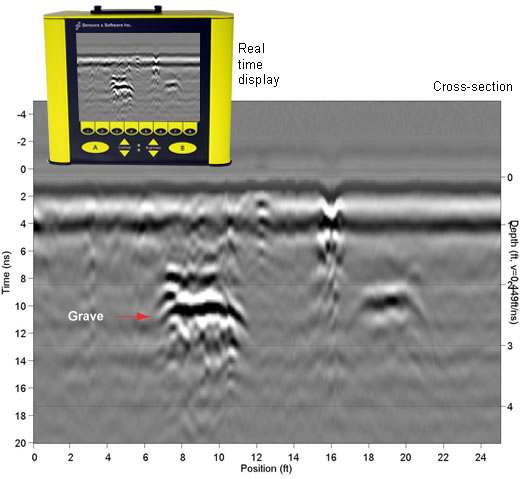

Results & Benefits
The above cemetery mapping demonstrates the value of GPR for confirming grave locations. Some key benefits are:
- The Noggin SmartCart is a compact, portable and rugged GPR for smooth to moderately rough field conditions
- Operation is simple and intuitive
- Users can be effective with only a few hours of training
- Systematic search protocols are available as best practice guides
- Locate and mark provides rapid and immediate zone of interest identification
- Grid mapping simplify data analysis and reduces false alarms
Download the case study: GPR for finding Graves in Cemeteries
Click here to learn more about Noggin Ground Penetrating Radar used in this case study.
GPR responses vary greatly depending on the target being sought and the host material. GPR response variability can be challenging to new GPR users. When learning about GPR, the best practice is to review several similar GPR case studies to develop an understanding of variability. Check for other insightful information on the resources tab to learn more.
Use Contact Us to reach our Application Specialists who can help you tap into Sensors & Software’s vast array of technical information.