

Trends & Insights from an Industry Pioneer
About Subsurface Reflections:
The goal of this blog is to share interesting and inspiring articles related to subsurface imaging and geophysics. Written by experts in the field of geophysics, ground penetrating radar, software development and data analysis, this is a source for insights about the practical application of technology in the field of subsurface imaging and a place to shed light on common misconceptions in the industry.
No Results Found
The page you requested could not be found. Try refining your search, or use the navigation above to locate the post.
Ground Penetrating Radar (GPR)

Dr. Peter Annan
Founder & CEO
Peter is the CEO of Sensors & Software. His scientific research has been recognized worldwide with numerous awards for his pioneering work in ground penetrating radar (GPR) instruments and data analysis methods. He has authored multiple scientific publications, patents, and technical reports and served on various government and professional committees.
Concrete Construction Practice Classifications
n many instances, historic construction practice may not be known or documentation readily retrieved. RoadMap GPR creates images and tabulated data which classify changes in construction practice. The example shown here is from an investigation of a section of Hwy. 401 near Toronto, Canada clearly show the unique character of joints in the subsurface concrete slab.
Cross-sectional data from the area, clearly show the unique character of joints in the subsurface concrete slab. The concrete slab is covered by 200 mm of asphalt.

The next example of GPR image shows a short section of the road. This character was observed over several kilometers indicating the uniform road construction practice.
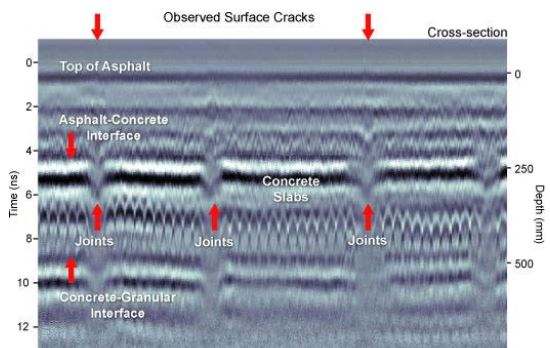
Survey data showing joints in a concrete slab covered by asphalt. Disturbance observed in asphalt above the joints indicates movement of asphalt layer has occurred above joints which lead to cracking and the potential for water inflow.
After correlating the GPR with other data, the abrupt localized changes were confirmed to be joints in the underlying concrete slab. The change in signal character is associated with fine grained material and water retained in the concrete joints.
Slight deformation of the asphalt structure above the joints suggest upward migration of the deformation. These characteristics are clear indicators of slab movement at the joints.
Download the case study: Construction Practice Classifications
When learning about GPR, the best practice is to review several similar case studies to develop an understanding of variability. Check for other insightful information on the resources tab to learn more.
Use Contact Us to reach our Application Specialists who can help you tap into Sensors & Software’s vast array of technical information.